
#Introduction
Great news for Azure networking practitioners — Azure DNS Private Resolver has reached General Availability (GA)! This is a significant milestone for organizations that have been relying on virtual machine-based DNS proxy solutions in their Azure environments.
In this post, I will cover what Azure DNS Private Resolver is, why it matters, and introduce a Terraform module I have created to simplify its deployment.
#What is Azure DNS Private Resolver?
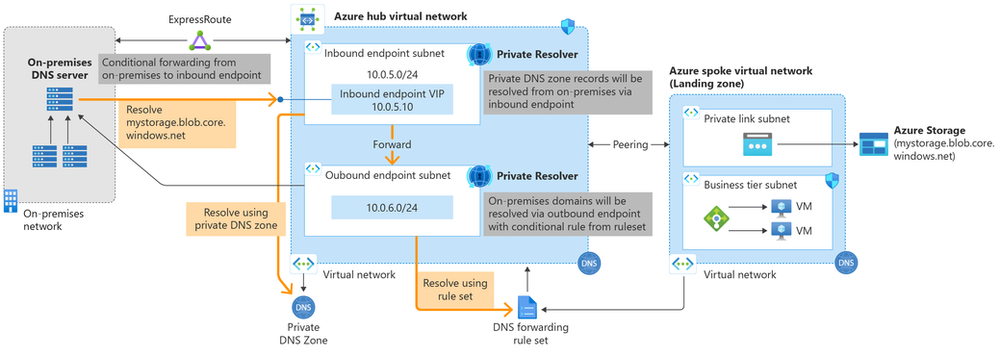
Azure DNS Private Resolver is a PaaS (Platform as a Service) offering that provides DNS resolution within your Azure virtual network. It acts as a DNS proxy that can forward DNS queries between on-premises networks and Azure, as well as between different Azure virtual networks.
Before this service, organizations typically had to deploy and manage virtual machines running DNS server software (such as Windows DNS Server or BIND) to provide DNS forwarding and conditional forwarding capabilities in Azure. This approach had several drawbacks that the DNS Private Resolver addresses.
#Benefits Over VM-Based DNS Servers
The shift from VM-based DNS servers to Azure DNS Private Resolver brings several significant benefits:
#Cost Reduction
- No VM costs — You no longer need to run dedicated VMs for DNS proxy services, saving on compute costs
- No OS licensing — Eliminates the need for Windows Server or Linux OS licenses for DNS VMs
- Reduced storage costs — No managed disks required for DNS VMs
#Reduced Management Overhead
- No OS patching — As a PaaS service, Microsoft handles all infrastructure maintenance and patching
- No DNS software management — No need to install, configure, and update DNS server software
- No high availability configuration — The service is built with high availability by default, eliminating the need for complex failover configurations
#Improved Reliability
- Built-in redundancy — The service is zone-redundant by default, providing resilience against datacenter failures
- SLA-backed — Comes with a Microsoft-backed SLA, unlike self-managed DNS VMs
- Automatic scaling — The service handles scaling automatically based on query volume
#Simplified Architecture
- Native Azure integration — Seamlessly integrates with Azure Private DNS Zones, Virtual Networks, and other Azure networking services
- Inbound and outbound endpoints — Clear separation between inbound (on-premises to Azure) and outbound (Azure to on-premises) DNS resolution
- DNS forwarding rules — Simple rule-based configuration for conditional forwarding
#The Terraform Module
To make deploying Azure DNS Private Resolver easier and more repeatable, I have created a Terraform module that encapsulates the deployment of all necessary resources.
#What the Module Deploys
The module creates the following resources:
- Azure DNS Private Resolver — The core resolver resource
- Inbound Endpoint — For receiving DNS queries from on-premises or other networks
- Outbound Endpoint — For forwarding DNS queries to on-premises or external DNS servers
- DNS Forwarding Ruleset — A set of rules defining where to forward specific DNS queries
- DNS Forwarding Rules — Individual forwarding rules for specific domains
- Virtual Network Link — Links the forwarding ruleset to target virtual networks
#Usage Example
module "dns_private_resolver" {
  source  = "haflidif/azure-dns-private-resolver/azurerm"
  version = "1.0.0"

  resource_group_name = "rg-dns"
  location            = "westeurope"
  virtual_network_id  = azurerm_virtual_network.hub.id

  inbound_endpoint_subnet_id  = azurerm_subnet.dns_inbound.id
  outbound_endpoint_subnet_id = azurerm_subnet.dns_outbound.id

  forwarding_rules = {
    "onprem-contoso" = {
      domain_name        = "contoso.local."
      target_dns_servers = [
        {
          ip_address = "10.0.0.4"
          port       = 53
        }
      ]
    }
  }
}
#Links
- Terraform Registry: haflidif/azure-dns-private-resolver/azurerm
- GitHub Repository: haflidif/terraform-azurerm-azure-dns-private-resolver
- Azure DNS Private Resolver Documentation: Microsoft Learn
- Azure DNS Private Resolver Pricing: Azure Pricing
#Conclusion
Azure DNS Private Resolver is a welcome addition to the Azure networking toolkit. It eliminates the need for VM-based DNS proxy solutions, reducing costs, management overhead, and complexity. If you are currently running DNS proxy VMs in Azure, I highly recommend evaluating the DNS Private Resolver as a replacement.
The Terraform module I have created should help you get started quickly and deploy the resolver in a consistent, repeatable manner. Feel free to check it out on the Terraform Registry or GitHub, and do not hesitate to open issues or contribute!